SIGN UP FOR NEWSLETTER
Be the First to Know. Sign up to newsletter today



Kausy M

303 views

add comment
India is an incredibly diverse country—geographically, culturally, and historically. An interesting State, which is often missed in the popular tourist itineraries, is Odisha. Odisha ( formerly Orissa ) is a State alongside the east coast of India. It is a treasure trove of traditional crafts and textiles, many of which are deeply tied to its temple traditions and tribal heritage.The Puri Jagannath Temple & the Konark Sun Temple are in Odisha.
Odisha’s history spans thousands of years and is marked by cultural richness and political significance. In the Ancient Period it was known as Kalinga, Utkala, and Odra Desha. Ports flourished along the coast in the 4th & 5th centuries BC. For instance, seafaring merchants went to Java, Sumatra, Borneo & Bali with their merchandise.After that, during the Medieval Period, the Eastern Ganga and Gajapati kings ruled this land and built architectural marvels such as the Konark Sun Temple & the Jagannath Temple.
And finally Odisha became a separate province in 1936, due to its Odia language and cultural identity.
It is a beach side town and the beach is a major attraction with its golden sands. The world renowned Jagannath Temple is in Puri. it is a Hindu Temple dedicated to Lord Vishnu. In addition, the Temple is known for its annual Rath Yatra Chariot festival. The deities of Lord Jagannath, Balabhadra & Subhadra are taken out on a procession around the city,in elaborately decorated Temple Cars. As a matter of fact, the festival dates back centuries and is considered the oldest and largest Hindu chariot festival.
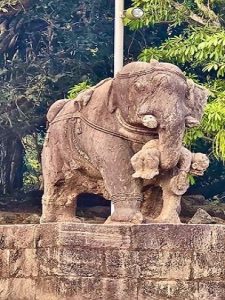
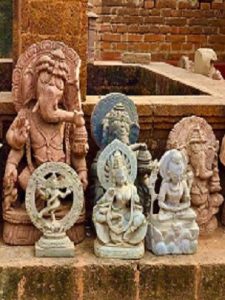
Stone Sculptures@Konark Temple
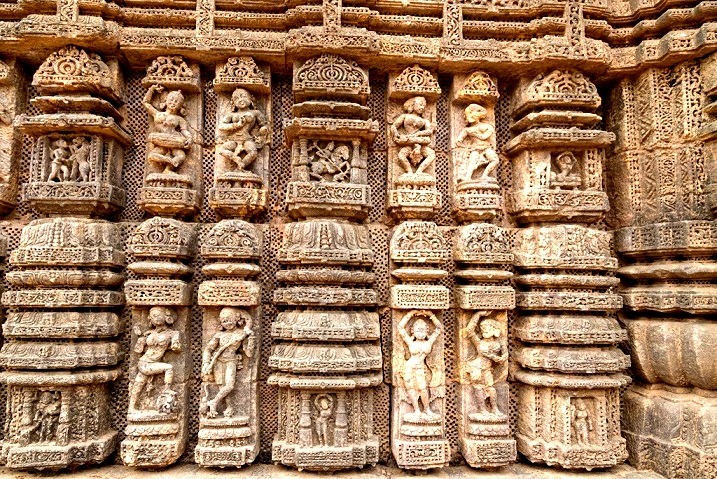
This UNESCO World Heritage is a Hindu Temple, dedicated to Surya, the Sun God. Above all, the temple was designed as a 100ft high chariot with 12 pairs of wheels & seven horses carved from stone. Konark is about an hour’s drive from Puri.
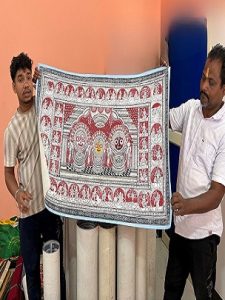
Artists display Pattachitra painting in Raghurajpur Artists Village
As a matter of fact, visiting Raghurajpur is like walking through an open-air art gallery. Every home is a studio and every lane tells a story of Odisha’s living traditions.For instance, the Pattachitra(painting on canvas) painting is most popular here & every home has a painter. Further, the village also nurtures Gotipua dance troupes. It is recognized as a heritage village by INTACH (Indian National Trust for Art and Cultural Heritage). It is an hour’s drive from Konark.
is famous for its temples. For example, the Lingaraj Temple, built in the 11th Century is dedicated to Lord Shiva. Above all, it is a fine example of Kalinga architecture and made with laterite stone. In addition, the beautifully sculpted tower is nearly 180ft high. Dhaulagiri Stupa is one of the famous Buddhist destinations near Bhubaneshwar. It is a place where the Emperor Ashoka, renounced the path of violence and embraced Buddhism. Moreover, one of the edicts of King Ashoka, dating from between 272 and 236 BCE, remains carved in rock, 8 kilometres (5.0 mi) to the southwest of Bhubaneshwar. Further, Udayagiri & Khandagiri are rock cut Jain caves near Bhubaneshwar.
The British made Cuttack the administrative Capital of Odisha. It is a twin city to Bhubaneswar. Some of the important Government offices are located there.
is Asia’s largest brackish water lagoon, bird sanctuary & dolphin sightings area. It is a biodiversity spot. It is the 2nd largest coastal lagoon in the world.
has an ancient sea port which was operational during the Kalinga reign. As a matter of fact, Gopalpur, was once a Dutch establishment. Subsequently, The East India Company built warehouses to trade with Burma.
The crafts & textiles of Odisha reflect its rich history. In other words, they are known for exquisite craftsmanship in stone, metal, & fine handlooms in silk & cotton.Above all, its culture takes inspiration from tribal, Jain, Buddhist Shaivite & Vaishnavite religions.
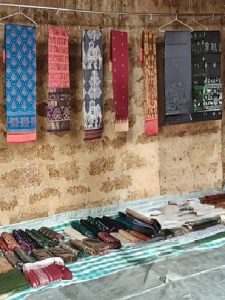
Handwoven Textiles in Nuaptana
Let us explore some of the Crafts & Textiles of Odisha
Above all, the devotion of the people of Odisha to Lord Jagannath has translated into adapting Vaishnava symbols into the weaving tradition of handlooms. Therefore, when the poet Jayadev(12th C Hindu poet) began writing the Gita Gobinda, he felt the most appropriate way to express his devotion was to weave the poems into the cloth woven for the Lord. Therefore, even today, we find Gita Govinda Pata or Kenduli Khandua (sacred handwoven fabric) is offered to the Lord with at least one popular verse from Gita Gobinda woven on it. In addition, the Nabakothi, with nine sacred symbols woven into nine houses or boxes in silk, is also a popular pattern.
For instance, Nuapatna, located about 70 km from Bhubaneswar in Odisha, is one of the most renowned weaving clusters in India.Further, it is celebrated for its unique Ikat weaving tradition, which has been practiced for centuries and continues to thrive today.
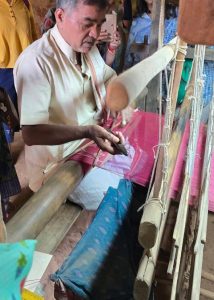
Nuaptana Village Master Weaver – Sarath Patra(Padmashree Awardee)
Contact – Sarat Patra ,Nuapatna,Odisha-7847933505 for spectacular sarees in cotton & silk.
Other handloom types include,
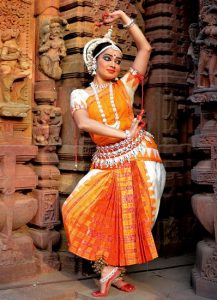
Odissi Temple Dance
Odissi – is one of the oldest surviving dance forms that originated in the temples.For example, it has distinct postures as can be seen in some of the temple carvings. In other words, it is characterised by sensuous movements, pure dance steps(Nritta) & Abhinaya. (facial expression)
Gotipua Dance It is a traditional centuries old dance form. In fact, young boys dressed as females perform this dance to honour Lord Jagannath.
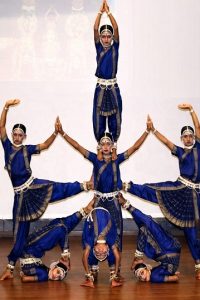
The Mayurbanj Chau is a semi classical martial dance form and is performed without masks. Further, Dhol Drums and Shehnai are used a s musical instruments.
Cuisine
The elaborate offering to Lord Jagannath-56 bhog (Chappan Bhog) is part of the temple rituals. As a matter of fact, it is cooked in a unique way in the temple premises. Earthen pots are kept one on top of the other over the burner. The pot at the top cooks first. The prasad (temple food) feeds all the devotees who visit the temple everyday with no shortage ever.
Some of the famous sweet dishes of Odisha include, Rasagolla ,Chenna Poda ,Khaja& Malpua.
In conclusion, Odisha’s temples are not isolated monuments. They ensure that the rich heritage & glorious history is preserved. As a matter of fact, they drive the rhythm of everyday life &provide a strong cultural identity. The temples safeguard traditions through their rituals, dance, music & painting.
With Contributions from Dr. Kanaka Durga
Visit Utkalika -The Odisha State Emporium in Delhi
TO BUY ORIGINAL PATTACHITRA PAINTINGS
CONTACT
Narayan Bariki (Bada Thakur Arts) at Heritage village Raghurajpur
9937679984/09938505532
email-badathakurarts@gmail.com
Be the First to Know. Sign up to newsletter today
